Sales funnel: how to build one in a CRM and stop losing leads
A sales funnel is a customer's path from first contact to payment, broken down into stages: inquiry, quote, commercial proposal, contract, payment. At each stage some people drop out, which is why the diagram looks like a funnel. Once the stages are written down, you can see exactly where you're losing customers.
In Kazakhstan, people search Google for «воронка продаж» ("sales funnel") about 590 times a month (Google Ads data, November 2026). Let's look at which stages a typical B2B company needs and how to run the funnel so that no inquiry gets lost.
Funnel stages for B2B
The stages depend on how you sell. For a company that sells building materials, rolled metal or machinery, the funnel usually looks like this:
| Stage | What happens | What matters |
|---|---|---|
| New inquiry | the customer messaged or called | reply within the first few minutes |
| Clarification | we find out the volume, timing and address | ask all your questions in one go |
| Quote and proposal | we've sent the price and terms | don't put off sending it |
| Negotiation | the customer compares offers and bargains | follow up at the right time |
| Invoice and payment | we've agreed and issued an invoice | check that the payment has arrived |
| Shipment | the goods are with the customer | ask for a review and a repeat order |
You don't need more stages than your manager has actions to take. Five to seven stages are enough for almost everyone.
How to run the funnel
While inquiries are few, you can run the funnel in a spreadsheet. Once there are more than a dozen a day, the spreadsheet stops working: managers forget to update the rows, and management can't see what's going on. That's when the funnel moves to a CRM:
- each inquiry is a card that moves through the stages;
- each card has a next step and a date: call, send a proposal, follow up;
- WhatsApp chats and calls are saved in the card;
- management sees how many inquiries are at each stage and which manager they're stuck with.
Which numbers to watch
- How many inquiries came in during the week, and from where.
- The conversion rate from one stage to the next: for example, how many inquiries led to a quote.
- Where you lose the most: if people get a proposal and disappear, the problem is the proposal or the price, not the ads.
- How long a deal takes, so you know when to follow up.
The most common mistake is spending money on new inquiries when half of the old ones were simply never answered.
An example from our work
For KAZ-JOL, a heavy machinery company in Almaty, we built a custom CRM platform: dispatch, requests, orders and shifts in one system; clients, sites, machinery and staff in directories; and tracking for every single machine. The platform works in Russian and Kazakh, and you can open its demo account and take a look.
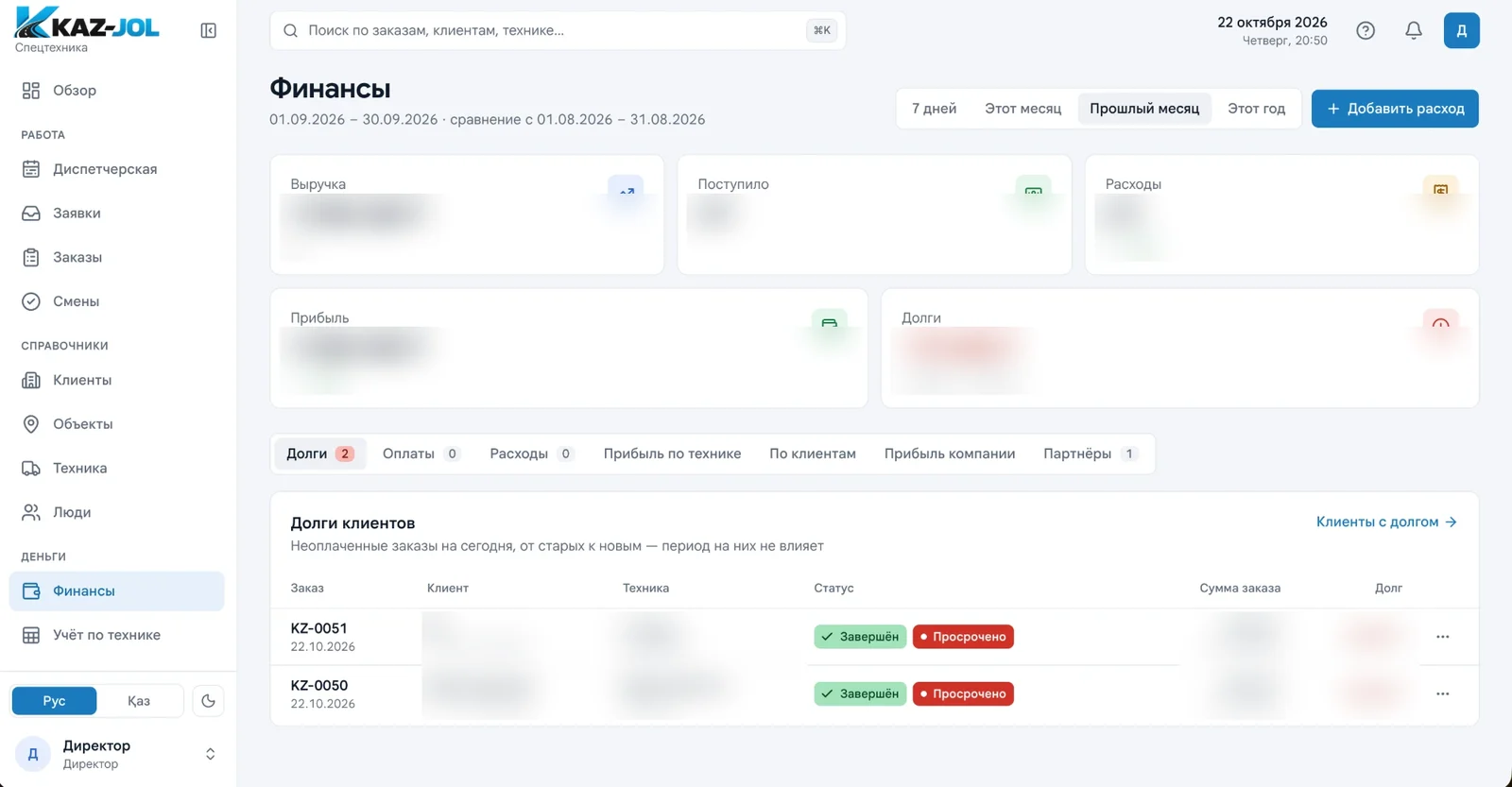
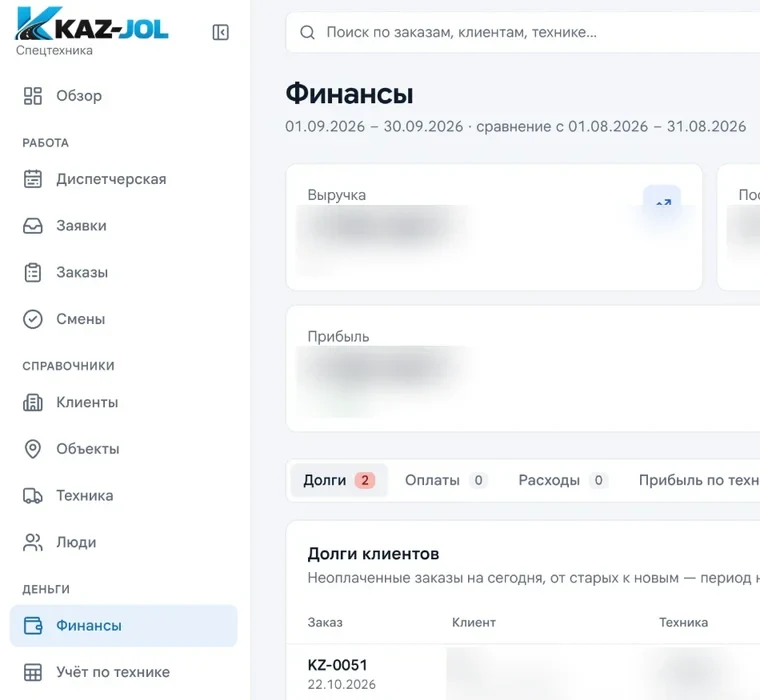
A CRM platform for the company
- Dispatch, requests, orders and shifts in one system
- Clients, sites, machinery and staff in one directory
- Finances and accounting for every machine, in Russian and Kazakh
Amounts and client data in the screenshot are hidden.
If you want to see your whole funnel, we set up a CRM around your sales process: stages, reminders, WhatsApp and reports.
Frequently asked questions
A funnel is the stages of your sales process. A CRM is the software where you run those stages and can see every inquiry.
As many as your manager's real steps. Usually five to seven.
Yes. Even with five inquiries a day, it's important to see who got a reply, who was sent a quote and who is waiting for a call.
Count how many inquiries moved on to the next stage. The step where the fewest move on is the one to fix.
Let's bring order to your sales
We'll map out your customer's path, build a funnel in a CRM and connect WhatsApp so that no inquiry gets lost. Leave a request below, and we'll show you how it would work for you.